COP architects livid at loss of weather justice at pivotal summit
 [ad_1]
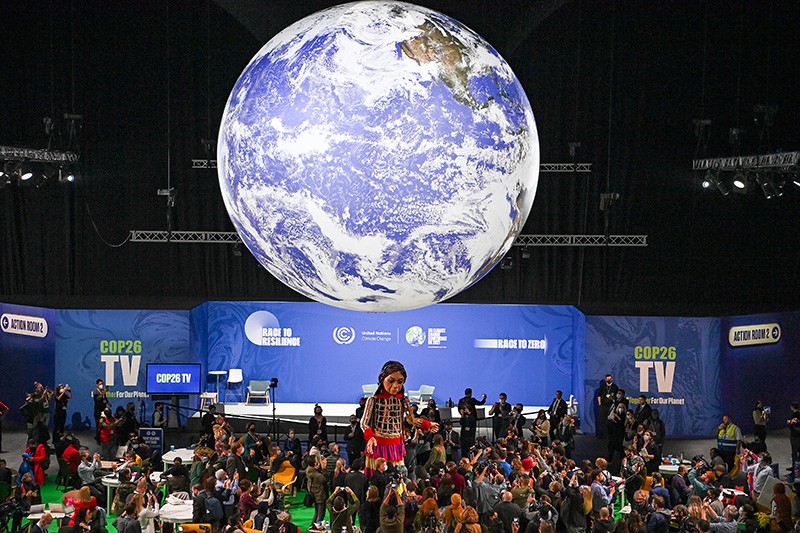
A large globe hangs from the ceiling of the convention corridor at COP26, the place weather negotiations are ongoing.Credit score: Jeff J Mitchell/Getty
Researchers who helped to draft portions of the primary United International locations environmental agreements just about 30 years in the past say that that low revenue nations are being hugely let down within the present COP26 weather talks.
The 1992 UN Earth Summit in Rio de Janeiro, Brazil, was once attended via scientists and policymakers from wealthy and deficient nations. “I used to be so hopeful,” says ecologist Zakri Abdul Hamid, who was once the clinical adviser to Malaysia’s delegation, as he recollects how he “morphed from a straight-laced younger educational” to a systematic policymaker.
“I had excessive hopes in Rio,” provides Saleemul Huq, a weather scientist from Bangladesh who was once an adviser to climate-vulnerable nations attending Rio.
The summit ended in UN agreements to take on weather replace and biodiversity loss, and a brand new UN center of attention on sustainable building. However Zakri now thinks he was once “naive” to be expecting rich international locations to stay their guarantees to give protection to the pursuits of poorer nations.
As the second one week of negotiations on the twenty sixth UN Local weather Trade Convention of the Events (COP26) will get below manner in Glasgow, UK, low-income international locations are deeply crucial concerning the sluggish tempo of decarbonization, and say that pledges to ship investment have now not been honoured.
Landmark settlement
Rio was once an important assembly as a result of policymakers from wealthy and deficient nations settled on what appeared to be an equitable formulation to give protection to the surroundings from the worst results of industrialization. The guidelines that ended in the summit had in large part come from high-income nations. Decrease revenue international locations had been involved that a climate-change or biodiversity settlement would save you them from construction their very own industries and trendy infrastructure.
In reaction, richer nations agreed to take at the burden of decarbonizing and decreasing biodiversity loss, whilst giving poorer nations extra time to industrialize. However they've now not finished this, says Zakri, who went directly to chair the Intergovernmental Science-Coverage Platform on Biodiversity and Ecosystem Products and services.
In a file printed forward of COP26, researchers on the Centre for Science and Surroundings (CSE) in New Delhi labored out that between 1990 and 2019, the highest-income countries were responsible for two-thirds of greenhouse-gas emissions. Rich international locations additionally did not abide via the 1997 Kyoto Protocol, a world legislation to cut back emissions via a mean of five% from 1990 ranges between 2008 and 2012.
From the early Nineteen Nineties onwards, ‘contraction and convergence’ received reputation so that you could spice up fairness. The theory was once that high- and low-income nations would each decarbonize, however at other charges — with richer nations slicing emissions extra temporarily (‘contraction’) — till emissions from the 2 teams converged at the similar per-capita stage. The theory quickly attracted influential policymakers from each high- and low-income nations, together with China and america, in addition to from UN businesses.
“It angry no-one; it united everybody. It's equitable. It's inclusive,” says the theory’s major architect, Aubrey Meyer on the World Commons Institute in London. However this toughen for the idea that did not translate into significant motion.
“These days, 30 years later at COP26, maximum environmental issues have worsened,” says Zakri, and richer international locations have now not been held to account.
Sunita Narain is director-general of the CSE and co-authored its file with climate-policy specialist Avantika Goswami. Narain says the 2015 Paris weather deal — the settlement to restrict international warming to underneath 2 °C above pre-industrial ranges — has ended up weakening commitments to fairness. For the reason that settlement was once signed, lower-income nations also are anticipated to begin to cut back their emissions. But those nations produce a fragment of the greenhouse gases of the massive emitters, she says.
“The truth is that Paris has now not given us the distance to develop,” says Narain, who was once on the Rio summit representing CSE. She worries that pledges from the massive emitters to reach net-zero emissions via or after 2050 will allow richer nations to “proceed to take extra of the carbon funds”, except strict meantime goals are enforced.
Investment failure
The Rio veterans also are livid about damaged guarantees on weather finance. The 1992 deal stipulated that richer nations would offer investment to give protection to climate-vulnerable nations from the results of world warming, and to assist them to broaden new applied sciences.
A $1 billion fund known as the World Surroundings Facility was once established, and this is able to be adopted via different modest weather investment pots. At COP15 in Copenhagen in 2009, richer international locations agreed on a extra life like determine that may fit the desires of low and center revenue nations: they promised to supply US$100 billion a year from 2020 to 2025. The 2020 goal was once overlooked, and greater than two-thirds of the investment that has been given is within the type of loans, now not the “new and further finance” that was once anticipated after Rio, says Tariq Banuri, a former director of sustainable building on the UN in New York, who represented Pakistan on the 1992 Earth Summit.
Banuri says the COP negotiation procedure that he, Huq, Zakri, Narain and others helped to create is not a lot more than “institutional remedy” for the richer nations. “They're enticing in a failed procedure to reassure themselves that they're doing one thing. I'm very pessimistic concerning the COP,” he says.
On the similar time, there’s a consensus that hope will have to now not die.Massive numbers of scientists and younger other folks from science, activism and coverage are provide for the COP in Glasgow. “They will have to proceed to talk reality to energy,” Narain says.
Huq, who based the Global Centre for Local weather Trade and Construction in Dhaka, says nations will have to proceed to paintings in the course of the UN, collaboratively, to get justice. “The United International locations is the nearest factor the arena has to an international governance frame,” he says. “We need to persevere with it, despite the fact that it isn’t actually handing over.”


Comments
Post a Comment